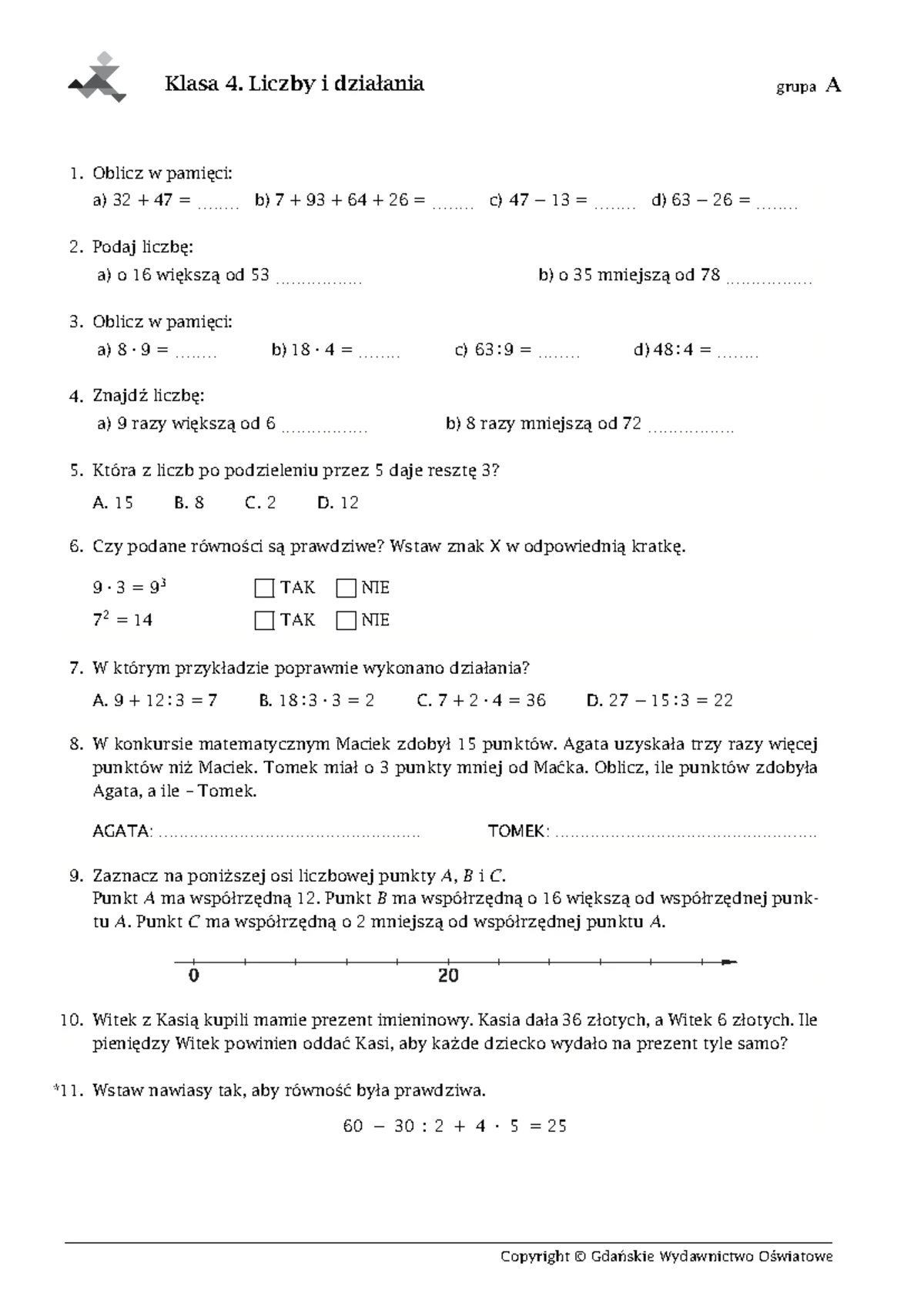
Sprawdzian Z Ułamków Dziesiętnych Matematyka Z Plusem Klasa 5
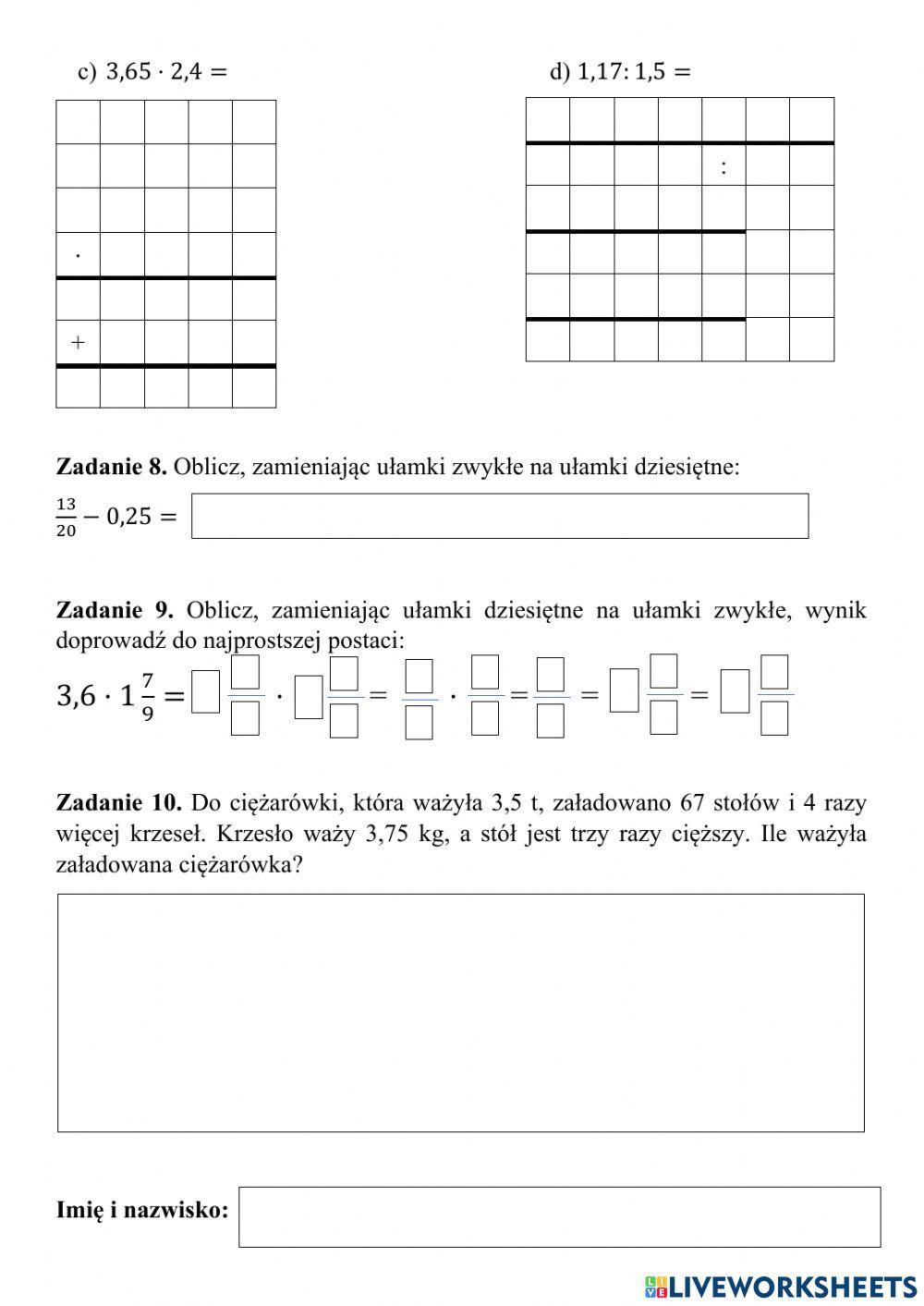
Sprawdzian z ułamków dziesiętnych (test from decimal fractions) in the "Matematyka z Plusem" textbook for 5th grade focuses on understanding and performing operations with decimal fractions. The test assesses a student's ability to read, write, compare, and calculate using decimal numbers.
A key aspect is the ability to represent fractions as decimals and vice versa. This involves understanding that a decimal is a fraction with a denominator that is a power of 10 (10, 100, 1000, etc.). For example, 7/10 is equal to 0.7, and 23/100 is equal to 0.23. Students need to be able to convert back and forth between these representations.
Another crucial element is comparing decimal numbers. This requires comparing the whole number parts first. If the whole number parts are equal, then compare the tenths place, then the hundredths place, and so on. For instance, to compare 3.45 and 3.47, the whole number parts are the same (3), the tenths are the same (4), but the hundredths place is different (5 vs. 7), so 3.47 is larger.
Must Read
The test evaluates the ability to perform arithmetic operations with decimals, specifically addition, subtraction, multiplication, and sometimes division. Addition and subtraction require lining up the decimal points. Multiplication is performed as with whole numbers, and then the decimal point is placed in the answer based on the total number of decimal places in the factors. Division often involves converting the divisor to a whole number by multiplying both the divisor and dividend by a power of 10.
Example 1 (Addition): Calculate 2.35 + 1.4. You would align the decimal points:
2.35
+1.40 (add a zero for alignment)
-------
3.75

Example 2 (Multiplication): Calculate 1.2 x 0.3. Multiply 12 x 3 = 36. Since there are a total of two decimal places in the original numbers (one in 1.2 and one in 0.3), the answer is 0.36.
A significant portion of the "Sprawdzian" often involves word problems. These problems require students to identify the relevant information, decide which operations to perform, and solve the problem using decimal numbers. The focus is on applying the learned concepts to practical scenarios.

Students are also expected to understand the concept of rounding decimal numbers to a specific place value (e.g., rounding to the nearest tenth or hundredth). The standard rounding rule applies: if the digit to the right of the rounding place is 5 or greater, round up; otherwise, round down.
Finally, an important aspect of understanding ułamki dziesiętne is recognizing their real-world applications. From calculating grocery bills to measuring ingredients for a recipe, decimals are essential in everyday life. The ability to work with decimals is a fundamental skill for managing finances, understanding measurements, and solving practical problems.