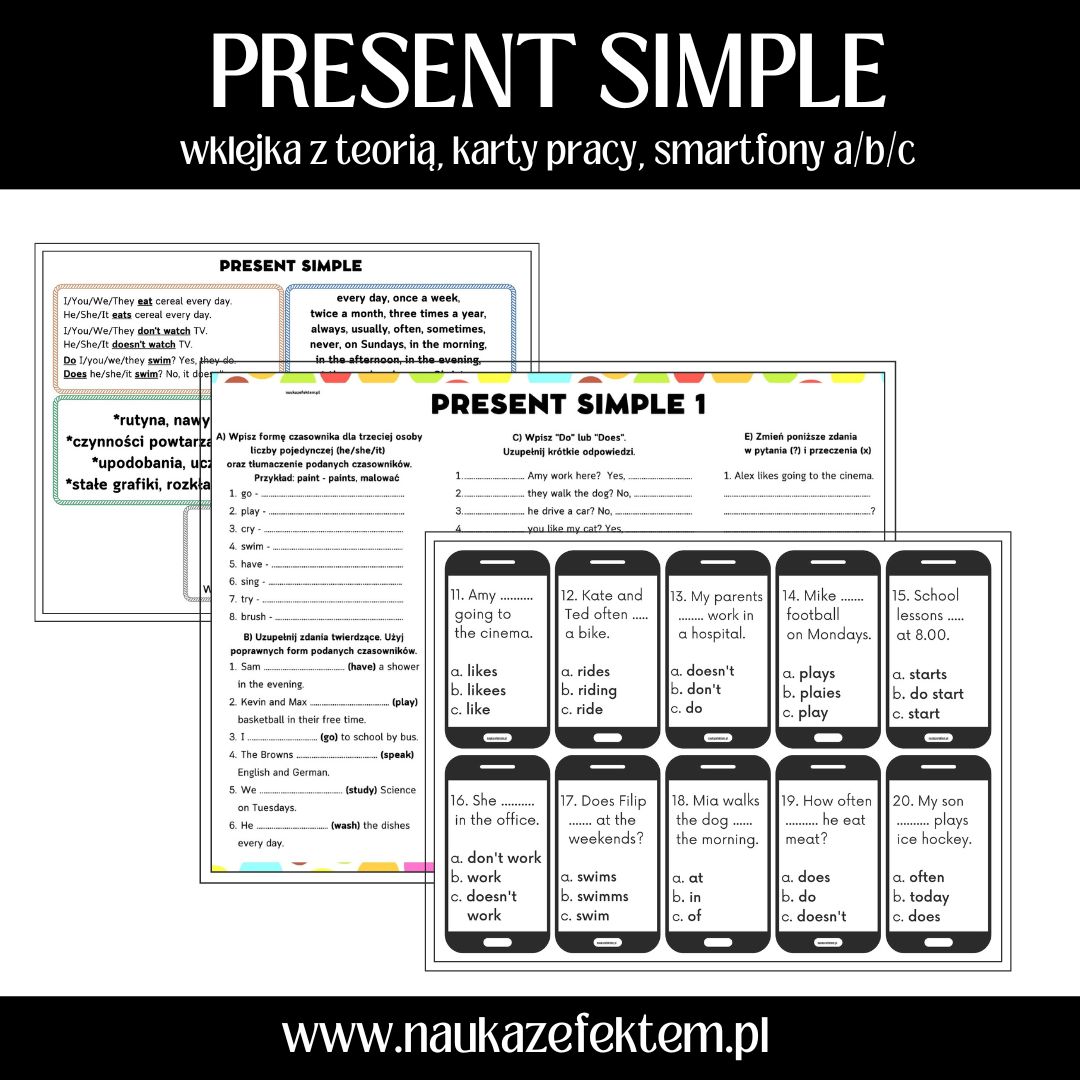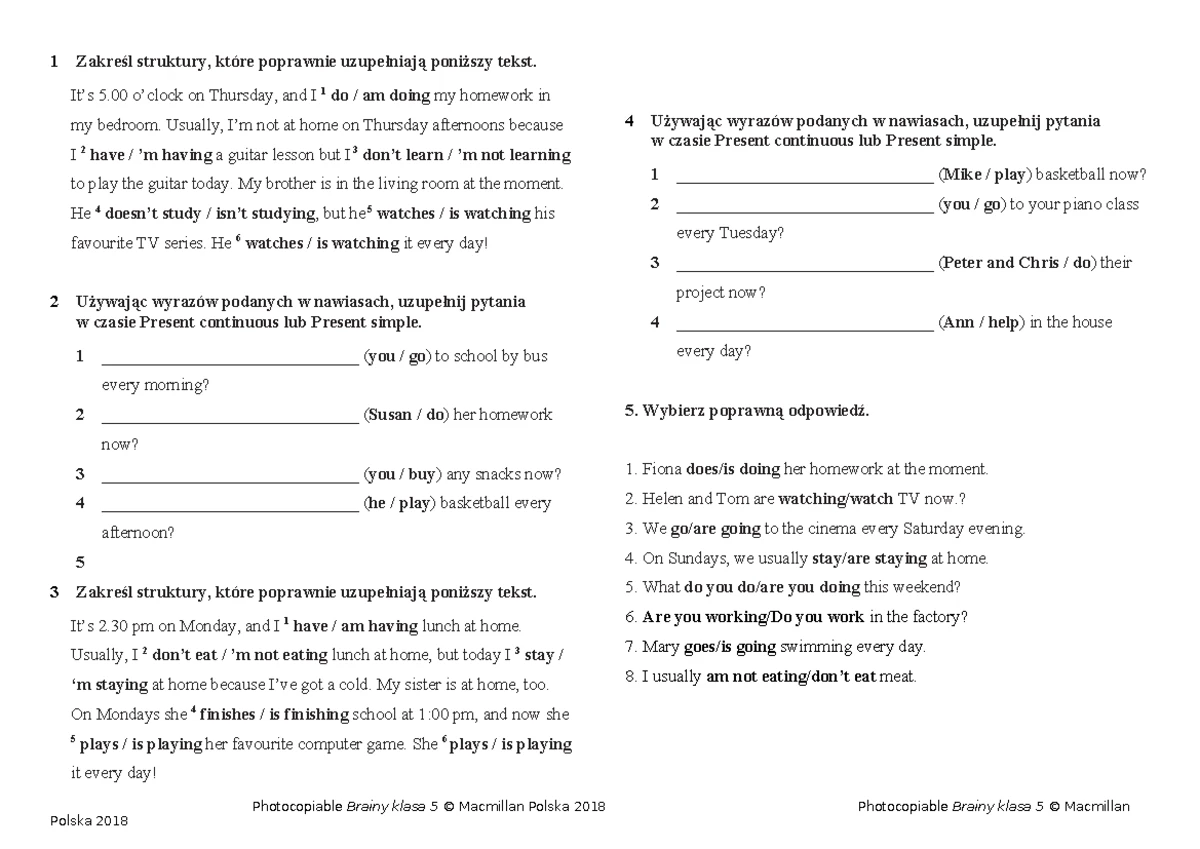
Quiz Klasy 5 Sprawdzian Z Present Simple Angielski

The Present Simple in English is used to talk about habits, routines, general truths, and facts. It describes actions that happen regularly or are always true.
Forming the Present Simple:
For most verbs, we use the base form of the verb in the Present Simple. For example, with the pronoun 'I', 'you', 'we', and 'they', the verb stays the same. For the third person singular ('he', 'she', 'it'), we usually add an -s to the end of the verb.
Must Read
Examples:
- I play football every Saturday. (Habit/Routine)
- She reads books before bed. (Habit/Routine)
- The sun rises in the east. (General Truth/Fact)
- Cats like milk. (General Truth/Fact)
Negatives:
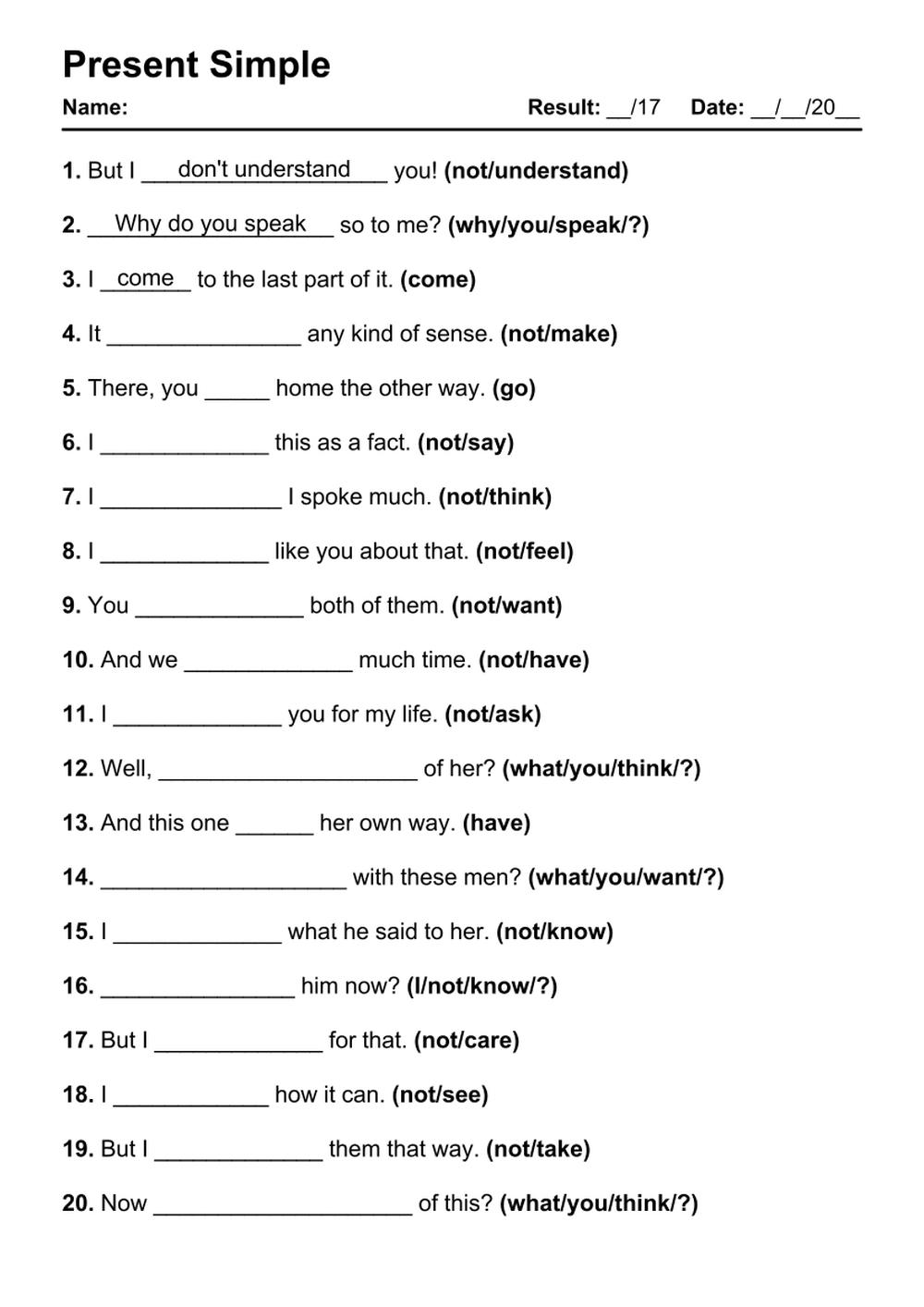
To form negative sentences, we use the auxiliary verb 'do' or 'does' followed by 'not' and the base form of the main verb. For 'he', 'she', and 'it', we use 'does not' (or the contraction 'doesn't'). For 'I', 'you', 'we', and 'they', we use 'do not' (or the contraction 'don't').
Examples:
- He doesn't play tennis.
- We don't watch TV in the morning.
Questions:
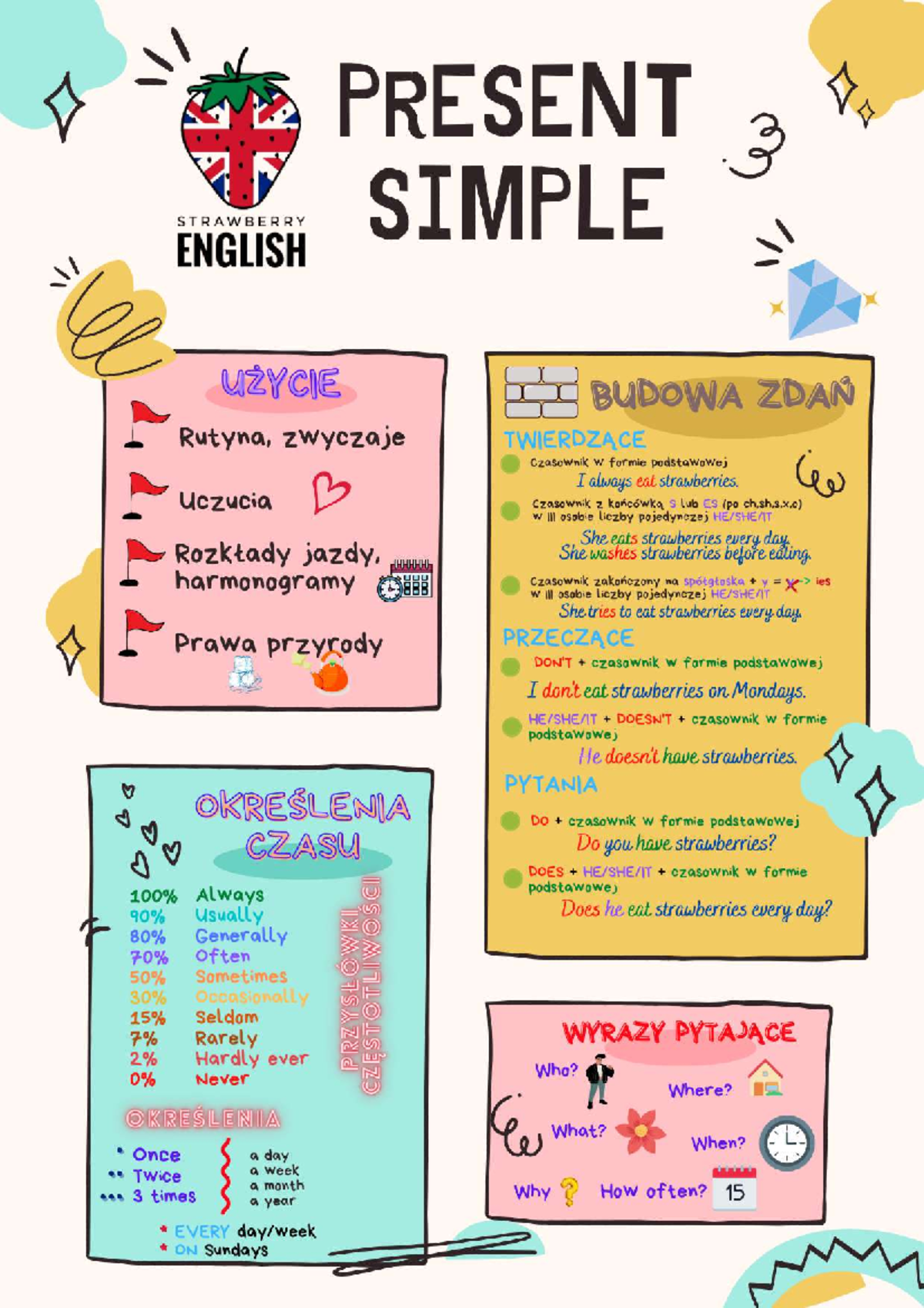
To ask questions, we place the auxiliary verb 'do' or 'does' at the beginning of the sentence, followed by the subject and the base form of the main verb. Again, 'does' is used for the third person singular, and 'do' for the others.
Examples:
- Does he play football?
- Do you like pizza?
Spelling Rules for Third Person Singular:
While adding -s is the most common rule, there are some exceptions:
- Verbs ending in -sh, -ch, -ss, -x, or -o take -es. Example: watch -> watches, go -> goes, fix -> fixes.
- Verbs ending in a consonant followed by -y change the -y to -ies. Example: study -> studies, try -> tries.
- Verbs ending in a vowel followed by -y add -s. Example: play -> plays, say -> says.
Time Expressions:

The Present Simple is often used with time expressions that indicate frequency, such as 'every day', 'always', 'usually', 'often', 'sometimes', 'never', and 'once a week'.
Real-World Application:
The Present Simple is fundamental for everyday communication. It allows us to describe our daily lives, express our preferences, state facts about the world around us, and understand simple instructions or descriptions. For example, when you tell someone what you do for a living, what your hobbies are, or describe how something works, you are likely using the Present Simple.